Argo AI Home

Category

Architecture & Systems Design

24 articles

Seven Failure Modes Every Agentic System Reveals After the Demo Ends

Seven Failure Modes Every Agentic System Reveals After the Demo Ends

Agentic AI systems perform flawlessly in demos and fall apart in production, where tool-call loops drain budgets and small planning errors compound into outages. This article catalogs seven real-world failure patterns for LLM agents and the guardrails that catch each one before it pages your on-call engineer.

The Multi-Node Mirage: Quantifying Distributed Training Overhead Before Committing to the Architecture

The Multi-Node Mirage: Quantifying Distributed Training Overhead Before Committing to the Architecture

Distributed training is frequently treated as the default solution for large model workloads, but the communication overhead between nodes can silently consume the throughput gains that motivated the architecture in the first place. This article provides a quantitative framework for measuring the true cost of inter-node communication, identifies the conditions under which single-node optimization delivers superior economics, and establishes concrete decision criteria for evaluating distributed t

Blind at Launch: Engineering ML Observability That Works Before You Have Enough Data to Trust It

Blind at Launch: Engineering ML Observability That Works Before You Have Enough Data to Trust It

Most ML monitoring frameworks are designed for steady-state operation, leaving production systems functionally blind during their most consequential phases—initial rollout and rapid traffic growth. This article examines the structural reasons observability infrastructure consistently lags deployment timelines and presents a concrete engineering framework for building monitoring that is operational from the first prediction, not the thousandth.

When the Pipeline Isn't Yours: Managing Cascading Failures Across Third-Party AI Dependencies

When the Pipeline Isn't Yours: Managing Cascading Failures Across Third-Party AI Dependencies

Contemporary AI systems are deeply entangled with external services—managed embedding APIs, proprietary LLM endpoints, third-party vector stores, and vendor-hosted model infrastructure. Each dependency is a potential failure vector that conventional ML engineering practices were not designed to handle. This analysis examines the structural risks introduced by external AI service dependencies, the business consequences of architectural lock-in, and the design principles that enable production sys

Eliminating Redundant Computation in Multi-Model Pipelines: A Practical Guide to AI-Layer Cache Coherence

Eliminating Redundant Computation in Multi-Model Pipelines: A Practical Guide to AI-Layer Cache Coherence

Production AI systems that run multiple models in parallel or sequence frequently recompute the same embeddings, features, and intermediate representations dozens of times per request. This article examines the architectural patterns that allow engineering teams to detect, quantify, and eliminate this computational duplication without compromising model independence or system modularity.

Designing for Failure: Why Most Production AI Systems Lack the Resilience They Actually Need

Designing for Failure: Why Most Production AI Systems Lack the Resilience They Actually Need

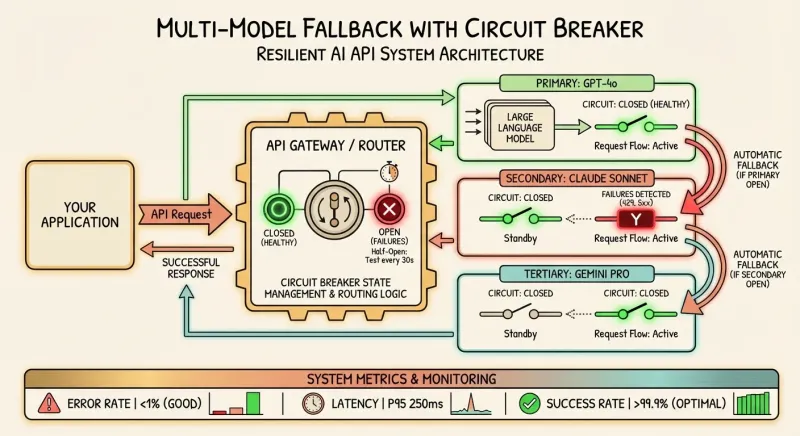
When primary AI systems fail, become unavailable, or begin producing unreliable outputs, most production deployments have no credible fallback strategy. This article examines the organizational and architectural patterns that lead to brittle AI infrastructure and presents concrete engineering approaches for building systems that degrade gracefully rather than failing completely.

Centralized and Fragile: Rethinking the Feature Store Before It Becomes Your ML Platform's Weakest Link

Centralized and Fragile: Rethinking the Feature Store Before It Becomes Your ML Platform's Weakest Link

Feature stores have become a standard recommendation in enterprise ML platform design, but the architectural assumptions that make them appealing in theory frequently produce latency bottlenecks, consistency failures, and operational complexity in practice. Before committing to a centralized feature platform, engineering teams deserve an honest assessment of what they are actually buying.

Gradual Decay: Engineering a Detection Framework for Model Drift Before It Becomes a Business Crisis

Gradual Decay: Engineering a Detection Framework for Model Drift Before It Becomes a Business Crisis

Model drift rarely announces itself. It accumulates quietly across thousands of inference calls until a business stakeholder notices revenue slipping or customer satisfaction declining — long after the technical window for early intervention has closed. This article examines why conventional monitoring stacks are architecturally ill-suited to catch gradual distributional shift, and provides a concrete engineering framework for building drift-aware observability into production ML pipelines.

Overlooked and Underestimated: The Real Performance Cost of Tokenization in Production LLM Systems

Overlooked and Underestimated: The Real Performance Cost of Tokenization in Production LLM Systems

Tokenization occupies an awkward position in LLM system design: technically mandatory, frequently invisible in performance profiles, and almost universally underestimated as a source of production latency. This analysis combines architectural examination with empirical benchmarking to quantify the tokenizer's true contribution to end-to-end latency, and presents optimization approaches that can deliver measurable gains without requiring model-level changes.

The Memory Allocation Trap: How Batch Size Decisions Made in Development Drain Production GPU Budgets

The Memory Allocation Trap: How Batch Size Decisions Made in Development Drain Production GPU Budgets

Batch size tuning is typically treated as a training-time optimization, but the decisions made during that phase propagate directly into production inference economics. This investigation quantifies how memory utilization choices create cascading inefficiencies in deployed serving infrastructure, and presents concrete engineering strategies for reclaiming throughput without introducing reliability risk.

Accounting for Unreliability: A Quantitative Framework for Measuring LLM Hallucination Costs in Production

Accounting for Unreliability: A Quantitative Framework for Measuring LLM Hallucination Costs in Production

Hallucinations in large language models are not merely an accuracy nuisance—they impose measurable, compounding costs across production pipelines that most engineering teams have never formally quantified. This article presents instrumentation strategies, baseline methodologies, and ROI calculations for mitigation approaches including retrieval-augmented generation and targeted fine-tuning. Understanding the true hallucination tax is the first step toward building systems that can actually affor

The Infrastructure Imperative: How Model Serving Decisions Outweigh Model Selection in Production AI

The Infrastructure Imperative: How Model Serving Decisions Outweigh Model Selection in Production AI

The AI industry's collective attention is disproportionately focused on model benchmarks and selection criteria while the serving layer—the infrastructure that actually delivers model outputs to users at scale—receives a fraction of the engineering investment it deserves. This piece makes the case, with specific case studies and a practical evaluation framework, that caching strategies, batching configurations, GPU utilization, and API gateway design routinely produce performance differentials a

Beyond the Spec Sheet: Engineering the Real Boundaries of LLM Context Windows

Beyond the Spec Sheet: Engineering the Real Boundaries of LLM Context Windows

Advertised context window sizes have become a competitive marketing metric, but the engineering reality is considerably more nuanced—attention quality degrades, retrieval accuracy drops, and effective throughput collapses well before the nominal token limit is reached. This article examines the empirical performance cliffs that practitioners encounter in production, provides reproducible testing methodologies for establishing genuine usable context boundaries, and outlines architectural patterns

When Convergence Deceives: Diagnosing the Hidden Generalization Failures Behind Clean Loss Curves

When Convergence Deceives: Diagnosing the Hidden Generalization Failures Behind Clean Loss Curves

Smooth training curves and steadily declining validation loss create a compelling narrative of model success — one that frequently collapses the moment production data arrives. This article examines the structural reasons why learning dynamics in controlled environments fail to predict real-world behavior, and offers engineers concrete diagnostic strategies to surface generalization failures before they reach deployment.

Precision Illusions: How Quantization Silently Erodes Model Performance Between Benchmark and Production

Precision Illusions: How Quantization Silently Erodes Model Performance Between Benchmark and Production

Quantization promises leaner models and faster inference, but the gains measured in controlled benchmarks routinely collapse under production conditions. Understanding why requires a close examination of how reduced-precision arithmetic interacts with real data distributions, hardware-specific rounding behaviors, and the compounding effects of serving infrastructure—factors that standard evaluation pipelines rarely surface.

Vectors at Scale: The Engineering Costs of Embedding Infrastructure That Benchmarks Ignore

Vectors at Scale: The Engineering Costs of Embedding Infrastructure That Benchmarks Ignore

Embedding-based retrieval has moved from research novelty to production necessity, but the infrastructure costs that emerge at scale rarely appear in vendor benchmarks or conference papers. This analysis examines the compounding tradeoffs across dimensionality, quantization, and approximate nearest neighbor design that ML engineers must resolve before embedding pipelines become system-wide bottlenecks.

The Production Blindspot: Why Validation Accuracy Is Misleading Your ML Deployment Strategy

The Production Blindspot: Why Validation Accuracy Is Misleading Your ML Deployment Strategy

Validation accuracy tells you how a model performed on a curated dataset — it says almost nothing about how it will behave under the pressure of real-world traffic, shifting data distributions, and latency constraints. This article examines the instrumentation framework that separates models that thrive in production from those that quietly degrade, offering concrete tooling guidance and threshold benchmarks for ML engineers building at scale.

State Space Models vs. Transformers: A Rigorous Engineering Assessment for Production AI Teams

State Space Models vs. Transformers: A Rigorous Engineering Assessment for Production AI Teams

State Space Models like Mamba are challenging the transformer's decade-long dominance with compelling efficiency gains on long-sequence tasks. This technical assessment breaks down the mathematics, benchmarks, and real-world trade-offs ML engineers need to evaluate before committing to a new architecture. Walk away with a concrete decision framework built on data, not momentum.